

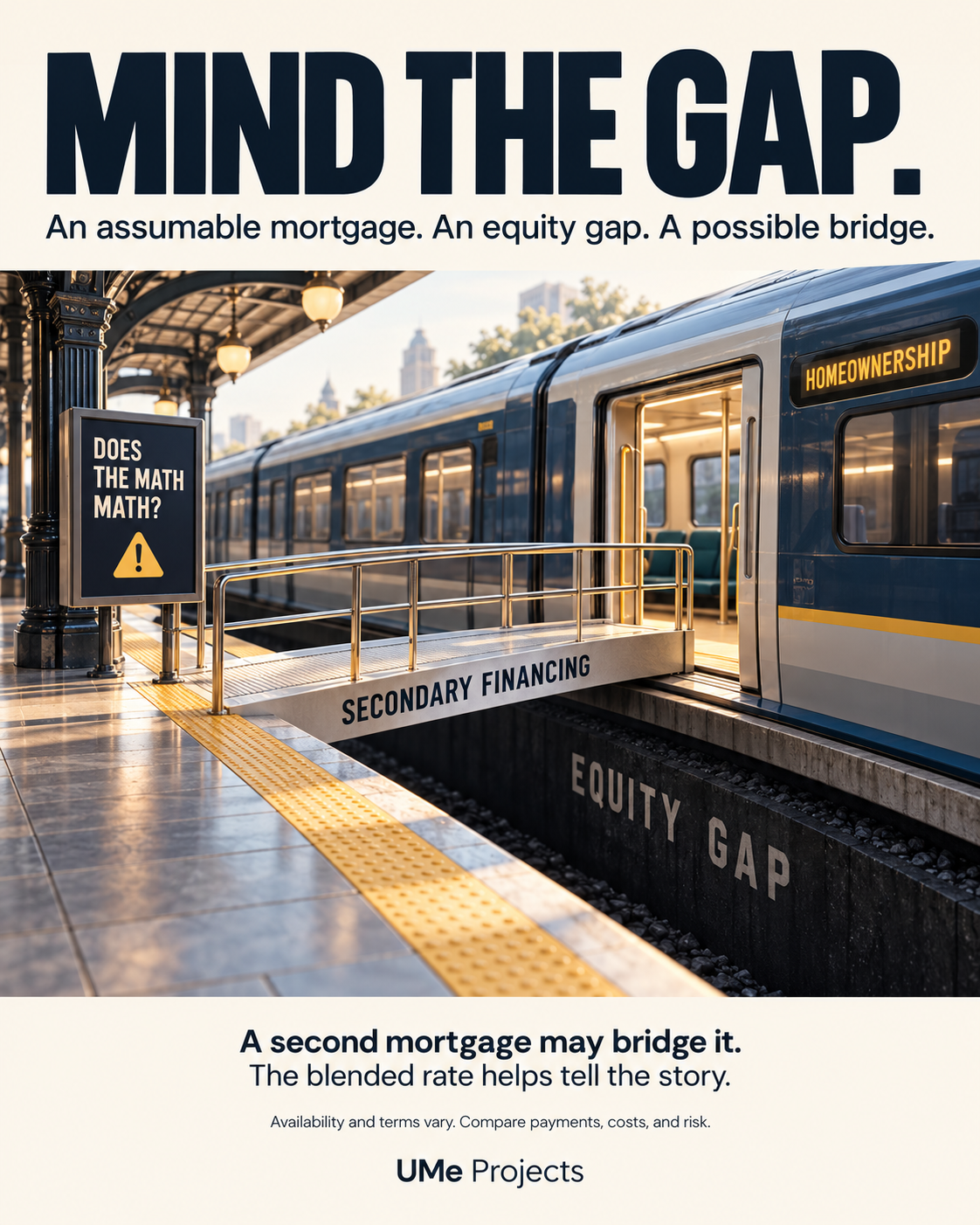
Yes, options exist. The real question is: Does the math math?
You find a home with an assumable mortgage. The interest rate looks great. Then you discover the seller owes less than the purchase price—and you need to cover the difference.
That difference is called the equity gap. It is one of the biggest questions buyers have about mortgage assumptions, and one of the most misunderstood.
A common response is, “You have to bring all of that money in cash. Nobody will do a second mortgage behind an assumption.”
That is too broad. Secondary financing can be available. The pool of lenders willing to fund a second mortgage alongside an assumption is small, and options depend heavily on the state, property, loan type, and buyer’s qualifications. But limited availability does not mean these transactions cannot happen.
At UMe Projects, we regularly work with assumptions that include secondary financing. We also know when the numbers do not justify it. Our job is to explain the options and compare them honestly—including traditional financing.
What is the equity gap?
In a mortgage assumption, an approved buyer takes over the seller’s existing loan rather than replacing it with a new first mortgage. The existing loan balance does not automatically increase to cover the home’s purchase price.
Purchase price − assumed mortgage balance = equity gap
For example, a home selling for $500,000 with an assumed mortgage balance of $350,000 has a $150,000 equity gap. The buyer must cover that $150,000 through acceptable funds, approved secondary financing, or a combination of both.
The gap is separate from closing costs, prepaid expenses, and any required reserves. It is also different from the seller’s net proceeds, which depend on selling expenses and other obligations. Exact closing figures can change as the mortgage balance changes.
Can you get a second mortgage with an assumption?
Yes, when the transaction and borrower qualify for an available program. A second mortgage sits behind the assumed first mortgage in lien priority. It provides separate financing without replacing the first mortgage.
For VA assumptions, this is explicitly addressed in VA Circular 26-24-17. VA does not prohibit secondary borrowing in conjunction with an assumption, including when the buyer is not a veteran. The second lien must remain subordinate, its terms must be documented, and its payment must be considered in qualification.
That guidance is specific to VA loans. FHA assumptions require their own review of applicable requirements. In either case, the first mortgage’s assumption requirements and the second lender’s underwriting requirements both matter.
The practical challenge is finding a lender that supports secondary financing at the time of the assumption purchase. A lender offering ordinary HELOCs to existing homeowners may not offer this type of purchase transaction. Funding and closing must be coordinated so the gap can actually be paid at settlement.
How much down payment is required?
There is no single nationwide answer. Among the secondary financing options we work with, some programs allow 100% combined loan-to-value, while others require 5% or 10% down. Availability is state dependent and also varies by lender and borrower profile. These are program examples, not a promise of approval or a statement that every lender in a state offers the same terms.
Combined loan-to-value, or CLTV, compares the first and second mortgages together with the property value the lender accepts.
(First mortgage + second mortgage) ÷ accepted property value × 100 = CLTV
The following shows how those limits could affect a $500,000 purchase with a $350,000 assumed first mortgage. It assumes the lender accepts a $500,000 property value, there are no other liens, and the program permits the illustrated second mortgage amount.
100% CLTV: First + second: $500,000. Second mortgage: $150,000. Buyer funds toward price: $0.
95% CLTV: First + second: $475,000. Second mortgage: $125,000. Buyer funds toward price: $25,000.
90% CLTV: First + second: $450,000. Second mortgage: $100,000. Buyer funds toward price: $50,000.
Zero down does not mean zero cash to close. Closing costs and prepaid expenses still need a funding plan. Reserves may also be required. Financing the entire price leaves no initial equity cushion from a down payment.
For HELOCs, some lenders calculate eligibility using the full approved line rather than only the amount drawn. Minimum line sizes, maximum loan amounts, property restrictions, and valuation rules can also affect what is available.
Why are many of these seconds HELOCs?
Many of the options we encounter are home equity lines of credit, or HELOCs. A HELOC is a revolving credit line secured by the property. In an eligible assumption purchase, funds drawn from that line can help pay the seller’s equity gap.
HELOCs commonly have variable rates. Some allow interest-only payments during a draw period, followed by a repayment period. If you pay only interest, you are not reducing the borrowed balance. A rate increase or transition into repayment can raise the payment. The Federal Trade Commission’s HELOC guide explains these features.
Ask about the index and margin that determine the rate, adjustment limits, draw and repayment periods, and any balloon payment. Review opening costs, ongoing fees, and early closure charges. Both mortgages are secured by your home, so both payments matter.
Does the math math? Start with the blended rate.
A higher rate on the second mortgage does not automatically erase the benefit of the lower rate on the first. The size of each loan matters.
A balance-weighted blended rate is a useful first look: multiply each borrowed balance by its interest rate, add those results, and divide by the total borrowed balance.
The rates below are hypothetical inputs for explaining weighted averages, not current quotes or offered loan terms. The calculations exclude fees and mortgage insurance. A blended rate is not an APR, a payment quote, or a guaranteed long-term borrowing cost.
When the low-rate mortgage represents most of the financing
Consider a $500,000 purchase with a $350,000 assumed first mortgage at 3.00% and a $100,000 second mortgage at 8.50%. The buyer contributes $50,000 toward the purchase price.
($350,000 × 3.00% + $100,000 × 8.50%) ÷ $450,000 = approximately 4.22%.
Even though the second carries a higher rate, most of the borrowed money carries the lower rate. That makes this structure worth comparing with a new first mortgage using the same buyer contribution. It does not, by itself, prove which option wins.
When the equity gap overwhelms the low-rate mortgage
Now consider an $800,000 home with only a $100,000 assumed first mortgage at 2.00%. Suppose, strictly for illustration, a buyer could finance the $700,000 gap at 8.50%.
($100,000 × 2.00% + $700,000 × 8.50%) ÷ $800,000 = approximately 7.69%.
The 2.00% headline rate applies to just one-eighth of the borrowing. It cannot make the other seven-eighths inexpensive. A $700,000 second may also exceed available program limits; this example demonstrates the math, not an available product.
This is the kind of scenario where the low-rate headline can lose its advantage. The complete comparison may favor traditional financing. We would never encourage a buyer to bridge the gap simply to preserve an attractive rate if the overall economics do not make sense.
A blended rate is the beginning of the comparison
Two financing structures can have similar blended rates and very different payments, fees, and long-term outcomes. A shorter remaining term on the assumed first mortgage affects the payment. An interest-only second can make the initial payment look smaller while leaving its principal balance unchanged.
A useful side-by-side comparison includes:
Total monthly housing cost: both loan payments, applicable mortgage insurance, property taxes, homeowners insurance, and HOA dues.
Cash needed: the buyer’s contribution, closing costs for both loans, prepaid expenses, and reserves.
Future payment exposure: higher HELOC rates and payments after the draw period ends.
Costs over your expected ownership period: interest, fees, mortgage insurance, and remaining balances when you expect to sell or refinance.
Your financial cushion: savings left after closing and whether the payments still work when expenses change.
Compare the same home, the same cash contribution, and the same ownership period. A lower payment caused by postponing principal repayment is different from a lower cost of borrowing.
The question is larger than “Can I qualify?” It is “Does this financing improve my position, and can I comfortably carry it?”
Can you refinance the HELOC later?
Potentially, yes. Using a HELOC to complete an assumption does not require keeping that exact second mortgage forever. After you own the property, you may be able to apply for a replacement second mortgage or another eligible home equity product while retaining the assumed first.
However, ownership does not automatically open every financing option. A future lender will evaluate its requirements at that time, including income, credit, property value, combined debt, and any seasoning requirements. Fees and lien coordination can also affect whether replacing the second is worthwhile.
At high CLTV, a lender with a lower maximum may require substantial principal reduction or additional equity before refinancing is possible. Refinancing both loans into a new first mortgage is a different decision: it replaces the assumed mortgage and its existing terms.
A future refinance can be an option. It should not be what makes an otherwise unaffordable purchase seem affordable today.
What should you have ready for an equity-gap review?
Start with the property’s state and purchase price, the current mortgage balance and interest rate, the loan type, remaining term, and any mortgage insurance. Then identify how much you can contribute while keeping an appropriate cash cushion.
From there, the review can address buyer qualification, eligible second mortgage programs, loan-size limits, estimated costs, and closing coordination. Evaluate the second alongside the assumption early, so the financing plan is clear before relying on it in an offer.
For listing agents and sellers, this matters too: a meaningful equity gap does not automatically limit your buyer pool to people who can pay the entire difference in cash. It does mean that financing eligibility and the combined payment need to be evaluated carefully.
The equity gap deserves a calculation
There are only a handful of secondary lenders in this space, and we would welcome more. But these options exist, and we work with them regularly.
Sometimes the assumption and second mortgage work beautifully together. Sometimes a larger cash contribution changes the outcome. Sometimes traditional financing is the better choice.
Our approach is straightforward: explain what is available, put the numbers side by side, and tell you when the math works—and when it does not.
Raise your hand. Let’s look at the numbers.
Looking at an assumable home and wondering how to cover the equity gap? Tell UMe Projects the state, purchase price, existing loan balance and rate, and what you are comfortable contributing.
We can help evaluate the assumption, potential secondary financing, and a traditional mortgage alternative. Connect with UMe Projects.
Educational information only; not a commitment to lend. Program availability, rates, loan limits, down payment requirements, and terms vary by state, lender, loan type, property, and borrower qualifications and may change. All financing is subject to applicable underwriting and approval. Hypothetical examples do not include all transaction costs or guarantee savings. Future refinancing is not guaranteed.
Further reading: VA secondary borrowing requirements for assumptions; CFPB: What you should know about HELOCs; FTC: Home equity loans and HELOCs.