

For decades, the mortgage industry has been built around originating the next loan. But as rates rise, millions of existing FHA and VA mortgages may deserve a second look.
For decades, the mortgage industry has known exactly which loan it wanted.
The new one.
Loan officers originate it. Lenders fund it. Investors buy it. Real estate agents understand it. Consumers know how to shop for it.
We built an entire ecosystem around creating the next mortgage.
And then there’s the assumption.
Not nearly as glamorous.
Mortgage assumptions can be operationally difficult. Servicing departments weren’t necessarily built to handle them at scale. They require patience, specialized knowledge and cooperation among parties who may have very little experience with the process.
And historically, many of the people surrounding a real estate transaction have had far more incentive to create a new mortgage than to transfer an existing one.
So, for the most part, the industry ignored assumptions.
Then the Math Changed
Millions of homeowners financed or refinanced during an extraordinarily low-rate environment.
Today, some of those homeowners have FHA or VA mortgages carrying interest rates that a new buyer may not be able to replicate with current financing.
And when market rates rise, something interesting happens:
The loan nobody really wanted to deal with starts looking pretty smart.
A 3%, 4% or 5% mortgage attached to a home isn’t necessarily just an old loan sitting in a servicing portfolio.
It can be an asset.
For a buyer, assuming an existing mortgage can potentially mean a significantly lower monthly payment and substantial interest savings compared with obtaining an entirely new mortgage at prevailing rates.
For a seller, an assumable mortgage can create a financial advantage that the house down the street simply cannot offer.
That changes the conversation.
A seller may no longer be marketing only the house.
They may also be marketing the financing attached to it.
Are We Overlooking the Mortgages We Already Created?
That raises a much bigger question for the mortgage industry:
Are we so focused on originating the next mortgage that we’re overlooking the value of the mortgages we’ve already created?
At UMe, we’ve spent the last several years working in this overlooked corner of the mortgage industry.
And we’ve learned something important along the way:
Many of the things people assume make these transactions impossible… don’t.
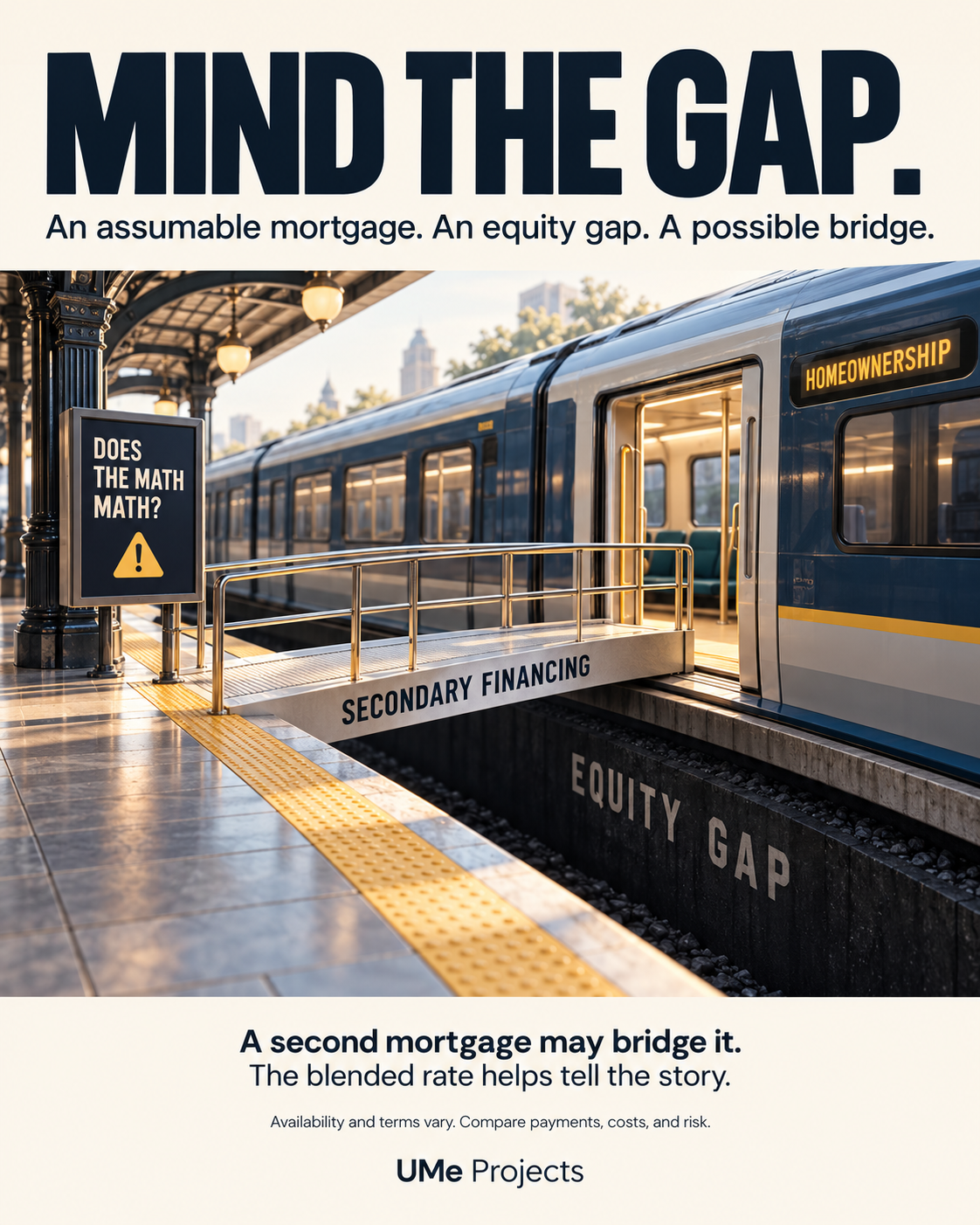
Large equity gap? There may be secondary-financing solutions that can help bridge the difference between the existing mortgage balance and the purchase price.
VA loan? The person assuming a VA loan does not necessarily have to be a veteran, although VA entitlement and other considerations can make the structure of the transaction important.
Difficult servicer process? Difficult isn’t the same as impossible.
That doesn’t mean every assumption works.
They can take longer than traditional financing. They can be operationally challenging. Not every property, borrower or existing mortgage will be a fit. And consumers need to understand both the benefits and the tradeoffs before deciding whether an assumption makes sense.
But assumptions are not theoretical.
They’re real.
We’re closing them.
The Wider the Rate Gap, the Harder They Are to Ignore
The economics of an assumption are ultimately driven by more than the interest rate. Buyers still have to consider the purchase price, remaining loan balance, equity gap, remaining term, mortgage insurance or funding considerations, secondary financing when applicable, closing costs and qualification requirements.
But the interest-rate spread matters.
And the wider the gap becomes between yesterday’s mortgage rates and today’s, the more attention these existing loans deserve.
For years, our industry had little reason to look closely at them.
Now we do.
Maybe the mortgage industry has spent enough time admiring the obvious choice.
There’s another one standing right beside it.
You just have to be smart enough to see it.
assUMe
We ARE closing the future’s assumptions today.